
Free Case Evaluation
Let's See If You Have a Case...
A Truck Accident Claim Is Paid by the Trucking Company's Insurance Company
If a semi, an 18-wheeler, or another commercial truck hit you, you may have a claim against the driver and against the trucking company that put the driver on the road.
That claim is paid by the trucking company's insurance company, and federal rules require a for-hire interstate trucking company to carry at least $750,000 in coverage for ordinary freight.
A truck accident lawyer looks for every company responsible for the truck, the driver, and the load, because each one can bring its own insurance policy.

Most of the proof is in records the trucking company controls, including the driver's logs, the truck's black box data, and the maintenance file.
Those records are easiest to save in the first days after the crash, so a written demand to preserve them goes out before anything else.
You do not have to give the trucking company's adjuster a statement, and you should talk to a lawyer before you do.
Our fee comes only out of money we recover for you, and we advance the costs of a truck case while it is open.
Call (888) 713-6653 at any hour to go over your truck crash with us, free.
- A truck crash claim can run against the driver, the trucking company, the shipper, and the freight broker
- For-hire interstate trucking companies hauling ordinary freight must carry at least $750,000 in liability insurance
- Driver logs, black box data, and maintenance records are easiest to preserve in the first days
- Filing deadlines are set by state law and run from one year to six
- The fee is a percentage of the recovery, and nothing is owed if there is none

Which Companies Besides the Driver Pay for a Truck Accident?
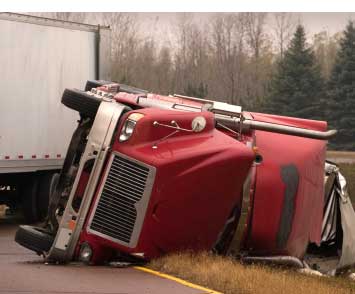
A car crash claim usually involves one driver and one policy. A truck crash claim usually has several companies behind the truck, and each one that shares responsibility adds its own insurance to what can pay you.
The trucking company comes first. It answers for a driver who was careless on the job, and it answers for its own decisions too. A company that screened a driver badly, handed the keys to a known risk, or kept dispatching a driver after the warnings piled up can face a claim for negligent hiring, entrustment, and retention. Some drivers are owner-operators working under contract, and the trucking company they haul for can often still be held responsible for a crash caused by an owner-operator driving as an independent contractor.
The load has its own chain of responsibility. The crew that loaded the trailer and the shipper that packed it can be responsible when unsecured cargo shifts or falls and causes the crash. The freight broker that arranged the haul can be responsible as well. On May 14, 2026, a unanimous U.S. Supreme Court ruled in Montgomery v. Caribe Transport II, LLC that federal law does not block a state-law claim against a broker that negligently hired the trucking company.[1] Since that ruling, freight broker liability belongs in the first review of any serious truck crash.
Two facts about the truck's owner change the procedure. When the truck belongs to a city, a county, or a state agency, many states require a written notice of the claim, sometimes within months of the crash, and a government-owned truck accident follows those rules from the first week. A trucking company based in another state can still be sued where the crash happened, and suing an out-of-state trucking company usually begins by serving the agent every interstate trucking company must name in each state where it operates.
A serious injury can cost more than one policy pays, which is the practical reason to work through the full list of who can be sued in a truck accident case.
How Jackknife, Underride, Blind Spot, and Brake Failure Crashes Point to Fault

The way the truck hit you says a good deal about what went wrong before it did. Each of the common types of truck accidents points to a particular failure and to the record that proves it.
- Jackknife. The trailer swings out of line with the cab and folds across the lanes. Jackknife truck accident claims usually trace to hard braking, too much speed for the conditions, or neglected brakes.
- Underride. A car slides beneath the trailer and takes the impact at windshield height. Underride truck accident claims often turn on a guard that was missing, rusted, or defective.
- Blind spot and wide turn. A truck driver has a duty to check the mirrors before changing lanes, turning, or backing up. A driver who skips that check causes no-zone and blind spot truck accidents and wide turns that squeeze cars against the curb.
- Brake failure. Overloaded trailers and skipped maintenance wear brakes out. When a driver says the brakes failed, the answer is usually in the truck's brake maintenance records.
- Tire blowout. A blown tire on a loaded truck can send it across lanes. A semi-truck tire blowout claim asks whether the cause was debris on the road or tires the company failed to maintain.
- Rollover and falling cargo. A turn taken too fast or a load stacked wrong can put a truck on its side or drop cargo into traffic.
- Rear-end and head-on. A loaded truck needs more distance to stop than a car, so a driver who is tired or in a hurry can hit the vehicle ahead or drift across the center line. The lane-position proof behind head-on crash liability works the same way for a truck as for a car.
- No contact. A truck that forces you off the road or into a guardrail without touching your car can still be responsible, and that is the basis of a no-contact truck accident claim.
Knowing which kind of crash you were in tells your lawyer which records to demand first.
18-Wheeler, Garbage Truck, and Delivery Van Claims and Who Answers for Each
The kind of truck tells you who is likely to be on the other side of the claim.
- 18-wheelers and semi-trucks. Tractor-trailers that cross state lines run under federal safety rules and carry the federal insurance minimums, which is why an 18-wheeler accident lawyer starts with the logs, the black box, and the trucking company's file.
- Garbage trucks. They work residential streets, stop often, and back up with limited sight lines. After a garbage truck accident, the responsible party can be the driver, the waste company, or the city that hired it.
- Delivery trucks and vans. The name on the side of the van is often a different company from the one that employs the driver. A delivery truck accident claim starts by finding out which, and that question decides who answers for an Amazon delivery van crash.
- UPS and FedEx trucks. The same question comes up after an accident involving a UPS truck or a FedEx truck crash, and the answer can differ from one company to the next.
- Tow trucks. Tow operators back into traffic and haul vehicles that can come loose at speed. A tow truck accident can involve the tow driver, the towing company, and the property owner who ordered the tow.
- Tankers. A tanker carrying fuel or chemicals can turn a crash into a fire or a spill, and a tanker truck accident claim can include people the truck never hit.
- Box trucks. Some are rentals, which can add the rental company to the list of responsible parties after a box truck accident.
- Dump trucks and flatbeds. Dump truck accidents can involve an overloaded bed or falling material, and a flatbed truck accident usually begins with how the load was tied down.
The 11-Hour Driving Limit and Other Federal Rules That Prove Fault
Trucking companies and their drivers work under safety rules written by the Federal Motor Carrier Safety Administration (FMCSA). When a company or a driver broke one of those rules and the violation helped cause the crash, the FMCSA violation is evidence of negligence in your claim.
Start with the limit on driving time. A driver hauling freight may drive no more than 11 hours inside a 14-hour window, and only after 10 straight hours off duty.[2] The federal hours-of-service rules set that limit because fatigue slows reaction time and judgment. Truck driver fatigue crashes often trace back to a delivery schedule that could not be met inside the legal hours.
The hours are recorded by a logging device in the cab, and the truck's electronic logging data shows when the driver was driving and for how long. The driver's own history sits in a file the trucking company keeps, and the driver qualification file and post-crash testing show whether that driver should have been behind the wheel at all.
Speeding, impaired driving, and distracted truck driving appear in these claims as well, and each one leaves a record in the black box, a test result, or the phone data.
The federal truck accident statistics show who carries the risk when a rule is broken. NHTSA counted 5,472 people killed in crashes involving large trucks in 2023, and 70 percent of them were occupants of other vehicles.[3]
For your claim, a proven rule violation moves the argument from what the driver says happened to what the records show.
The Logs and Black Box Data a Truck Accident Attorney Preserves First
After a serious crash, the trucking company or its insurance company will likely send people to the scene to gather evidence for their side. You do not have to speak with them.
Your side starts with a letter. A preservation demand sent in the first days puts the company on written notice to keep the driver's logs, the truck's data, the maintenance file, and the truck itself, which matters later if any of it goes missing.
Then the records are collected. The truck's black box data, taken from its onboard recorder, shows how the truck was being driven in the moments before the crash. When the two sides disagree about what happened, truck accident reconstruction uses that data and the physical evidence to establish the cause.
A police report helps, and so does a ticket, but your claim does not depend on either one. Fault in a civil claim is decided on all the evidence, and you can still sue a truck driver who was never ticketed.
The rest of what a truck accident lawyer does happens out of your sight. We deal with the adjusters, collect your medical records and bills, identify every responsible company, and prepare the case for trial from the first day.
While that work goes on, your job is to get treatment and keep your appointments.
Who Pays Your Medical Bills While the Truck Accident Claim Is Pending?
The trucking company's insurance company does not ordinarily pay your bills as they arrive. It pays once, in a settlement or after a verdict, so something else has to carry the bills in the meantime.
In a no-fault state, your own personal injury protection (PIP) pays first. PIP is the part of your auto policy that covers medical bills whoever caused the crash. In other states the bills go to medical payments coverage (MedPay), an optional part of an auto policy, and to your health insurance. A plan that paid may ask to be repaid from the settlement.
The money at the end comes from the truck's coverage. A for-hire trucking company hauling ordinary freight across state lines must carry at least $750,000 in liability insurance, and hazardous cargo carries higher federal minimums.[4] Policies are often stacked in layers, and the federal minimums and the excess policies above them decide how much there is to collect.

An insurance claim against a trucking company goes to a commercial adjuster, and an offer made before your treatment is finished cannot account for care you have not had yet. Some insurance companies also price injury claims with claim evaluation software such as Colossus, which scores the injury codes in your medical records.
When an insurance company refuses to pay a documented claim within policy limits, that conduct can support a bad faith action for more than the policy itself.
What Sets the Value of a Truck Accident Settlement?
The value of a truck accident settlement starts with your injuries and ends with the insurance available to pay for them. No lawyer can put a number on it until your doctors can say how far you will recover.
These are the things that move it:
- How serious the injury is and whether it is permanent. Brain injuries, spinal cord injuries, amputations, and severe burns can mean a lifetime of care.
- Your medical bills so far and the treatment your doctors expect you to need
- The wages you have lost and what the injury does to your ability to earn
- Pain, disability, disfigurement, and the loss of the life you had before the crash
- Your share of fault, if any. More than one person can share fault for a crash, including the injured person, and how fault is determined can reduce the recovery or, in some states, bar it.
- How many companies share responsibility and how much insurance each one carries
Where a driver or a company acted recklessly, some states also allow punitive damages, which are meant to punish the conduct.
How far each factor raises or lowers truck accident settlement amounts depends on the proof behind it, which is why the records described above come first. Most truck accident cases settle without going to court, and we prepare each one for trial in case yours does not.
When a Truck Crash Takes a Family Member
Some people do not survive a truck crash. State law decides who may bring a wrongful death claim, usually close family or the estate, and the claim can cover the medical bills before the death, the funeral, the income the family has lost, and the loss of the person's companionship. We help the family start the estate proceeding where one is needed, and we deal with the insurance companies so the family does not have to.
How Long Does Your State Allow for a Truck Accident Lawsuit?

Every state sets its own deadline, called a statute of limitations, for filing an injury lawsuit. The shortest is one year, in Tennessee. The longest is six, in Maine, Minnesota, and North Dakota, and most states fall at two or three. Find yours in the table of each state's injury filing deadline before you assume you have time.
The deadline to file a truck accident claim can be shorter still in two situations. A truck owned by a city, a county, or a state agency can bring a notice-of-claim requirement that runs in months in some states and does not exist in others. And in several states a family has less time to file a wrongful death claim than an injured person has to file an injury claim.
None of these deadlines protects the evidence. The logs, the black box data, and the truck itself can be gone long before the filing date unless someone demands in writing that they be kept.
If the deadline passes, a court will dismiss the case no matter how strong it was, so check the date early.
How Much Does a Semi-Truck or 18-Wheeler Accident Lawyer Cost?
You pay nothing up front. We work on a contingency fee, which means our fee is a percentage of what we recover for you, and if we recover nothing you owe no fee. The percentage is written into the fee agreement you sign at the start, so you know it before any work begins.
Truck cases are expensive to prepare. Reconstruction experts, medical experts, and records all cost money, and we advance those costs while the case is open. That arrangement is how a person with no savings can hire a truck accident attorney against a national trucking company.
The first conversation is free, at any hour, in English or Spanish, and we will come to your home or hospital room if you cannot travel. Our law firm has handled more than 40,000 injury cases and recovered more than $100 million for clients, and lead attorney Don Worley has more than 20 years of personal injury experience. We accept cases selectively, and we will tell you plainly whether yours is one we can take.
What to Do in the Days After a Commercial Truck Hits You
- Get medical care first, and go back if new symptoms appear.
- Photograph the scene, the vehicles, and your injuries, and get names and phone numbers from witnesses.
- Write down the company name on the truck, the USDOT number on the side of the cab, and the trailer number. If the truck kept going, those markings are how a truck hit-and-run gets traced back to a company.
- Keep your medical records, your bills, the crash report, and anything the trucking company or an insurance company sends you.
- Do not give a recorded statement or sign anything for the trucking company's insurance company until a lawyer has read it.
- Call a lawyer early enough for the preservation demand to do its job.
If you are too badly hurt to do any of this, a family member can make the call and we will take it from there.
Questions People Ask a Truck Accident Law Firm After a Crash
- Q: Should I talk to the trucking company's insurance adjuster?
-
A: You are not required to give the trucking company's insurance company a statement, and it is safer to speak with a lawyer first. The adjuster works for the company that will pay the claim, and what you say before you know the extent of your injuries goes into the file. You can tell the adjuster that your lawyer will be in touch.
- Q: Can I recover money if I was partly at fault for the truck crash?
-
A: In most states, yes. Your recovery is reduced by your share of fault, and many states bar it once your share reaches 50 or 51 percent. Four states and the District of Columbia can bar a claim for any share of fault, so check your state's comparative negligence rule before you accept the adjuster's version of who was to blame.
- Q: How much insurance does a trucking company have to carry?
-
A: Federal rules set the floor at $750,000 for a for-hire trucking company hauling ordinary freight across state lines, and the floor is higher for hazardous cargo. A company may carry additional policies above the minimum. The amount matters because a serious injury can cost more than a single policy pays.
- Q: Will my truck accident case go to trial?
-
A: Probably not, since most truck accident claims are settled before a trial. We still prepare each case as if it will be tried, and we file suit when the insurance company will not pay what the evidence supports.
Bring a Truck Accident Attorney the Crash Report and the USDOT Number
People come to us after a semi, a delivery truck, or a city truck has put them in the hospital, and families come to us after a truck crash has taken someone.
Lawsuit Legal deals with the trucking company and its insurance company so that you do not have to, starting with the written demand that keeps the logs and the truck's data from being lost.
If we take your case, our attorneys negotiate on your behalf and work to see you paid as much as possible, as fast as possible.
There is no fee for any of that work unless we recover money for you.
Call (888) 713-6653, day or night, for a free consultation in English or Spanish, and have the crash report and the company name or USDOT number from the truck with you if you can.
If you do not have either one yet, call anyway, and we will request the report ourselves.
Free Case Evaluation
Let's See If You Have a Case...