
Free Case Evaluation
Let's See If You Have a Case...
When an 18-Wheeler Hits You, the Rules Change
An 18-wheeler accident lawyer handles crashes involving tractor-trailers, semi-trucks, and other heavy commercial rigs, not fender-benders with bigger numbers.
A loaded semi can weigh 80,000 pounds. A passenger car weighs around 4,000.
That mismatch is why these crashes leave people with spinal injuries, amputations, brain trauma, and empty seats at the dinner table.
It is also why the case is governed by federal trucking regulations and backed by commercial insurance policies built to fight you.
The trucking company's crisis team is often at the scene before the wreckage is cleared, working to limit what they pay you.

You need a semi-truck attorney who knows where the evidence lives and how fast it disappears.
Call (888) 713-6653 for a free case review. You Win or It's Free.
- $100+ million recovered for the injured w/ a 98% recovery rate
- Trial-tested against the trucking industry's biggest insurers
- Free 24/7 case review - You Win or It's Free

Why 18-Wheeler Crashes Cause Catastrophic Injuries

The physics are brutal and one-sided. When an 80,000-pound tractor-trailer strikes a passenger vehicle, the energy has to go somewhere, and it goes into the smaller car and the people inside it. In crashes involving large trucks, the people killed are overwhelmingly the occupants of the other vehicle, not the trucker.[1]
A semi sits high off the ground, so a smaller car can slide underneath the trailer in an underride crash that shears off the roof. Tractor-trailers carry a high center of gravity, which makes them prone to rollovers and jackknifes that sweep across multiple lanes. And they need the length of a football field to stop from highway speed.
The result is a category of injury most car crashes never produce: traumatic brain injury, spinal cord damage and paralysis, crush injuries requiring amputation, and wrongful death. These are lifelong, life-altering losses, and valuing them correctly is the whole ballgame.
We frequently speak with families who lost a loved one in a collision involving a commercial truck. They often come to us searching for answers about what went wrong to cause the crash, and how to hold the responsible parties accountable.
The Most Common Types of 18-Wheeler and Semi-Truck Crashes
Tractor-trailers fail in predictable ways, and each crash type points to a different breakdown in driving, loading, or maintenance.
Jackknife crashes: the cab and trailer fold toward each other at a sharp angle, often from braking too hard or losing traction, sweeping across lanes and taking other vehicles with it.
Underride crashes: a passenger vehicle slides beneath the trailer when underride guards are missing, rusted, or fail on impact. These are among the deadliest tractor-trailer crashes on the road.
Tire blowouts: a failed steer or trailer tire sends a loaded rig swerving at speed. Many trace back to skipped maintenance or retreads run past their life. Our breakdown of what causes semi-truck tire blowouts and who pays for them covers how liability is sorted.
Rollovers: high center of gravity plus speed, a sharp ramp, or a shifting load tips the rig onto its side.
Wide-turn and squeeze crashes: a truck swinging wide to make a right turn traps a car in the gap on its right side.
Blind-spot (no-zone) crashes: large trucks have deep blind spots on all four sides, and a lane change into an unseen car causes a side-impact wreck.
Rear-end crashes: a rig that cannot stop in time slams into stopped or slowing traffic, which is devastating for the vehicle hit from behind.
The full range of commercial-vehicle fact patterns, and what each one means for proving fault, is laid out in our guide to the most common truck accident causes.
Who Is Liable for an 18-Wheeler Accident?
Many truck accident victims contact us because they need a legal team capable of handling complex cases involving trucking companies, commercial insurers, and catastrophic injuries.
Commercial truck crashes rarely have just one defendant, and that is good news for your recovery. More liable parties means more insurance coverage available to pay for what you lost.
The truck driver is scrutinized first, usually for hours-of-service violations, distraction, impairment, or unsafe speed for conditions.
The motor carrier faces vicarious liability for a driver operating under its authority, and direct liability for negligent hiring, inadequate training, or pressuring drivers to run past legal limits.
The freight broker or 3PL can now be sued directly for negligently selecting an unsafe carrier, after the Supreme Court's 2026 ruling. See how freight broker liability works after Montgomery v. Caribe.
The shipper or cargo loader is on the hook when an overloaded or unsecured load causes a rollover, jackknife, or spill.
Parts and truck manufacturers face product-liability claims when defective brakes, tires, or coupling hardware fail.
Sorting out every party whose negligence contributed to your crash is its own investigation. Our overview of all the parties that can be sued in a truck accident case walks through how the chain of liability spreads.
The Evidence That Decides a Semi-Truck Case
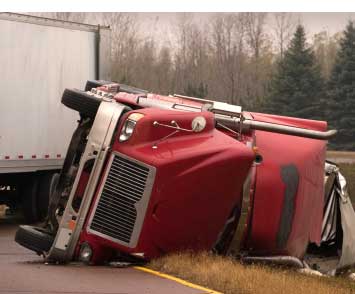
Most plaintiff lawyers make the same mistake on a trucking case: they treat it like a car accident case with bigger numbers. It is not. It is a regulated-industry case. The violation is the breach, and the mechanism evidence is the causation. That difference is where these cases are won.
A semi-truck case is built from records that a passenger-car claim never involves:
- Electronic control module (ECM) data, the truck's black box, capturing speed, braking, and throttle in the seconds before impact.
- Electronic logging device (ELD) and hours-of-service records, showing whether the driver was over the legal limit and how long.
- Dashcam and forward-facing camera footage, often overwritten within days if no one demands it.
- Maintenance and inspection files, revealing skipped brake and tire service.
- The driver qualification file and drug-and-alcohol testing records the carrier is required to keep.
This evidence has a short shelf life. A carrier is allowed to overwrite some logs on a regular cycle, and the truck can be repaired or sold before anyone inspects it. That is why a lawyer sends a spoliation letter demanding preservation within days of being hired, and why waiting is the costliest thing you can do. The regulatory side of this story, how a logbook or inspection failure becomes proof at trial, is covered in our guide to using FMCSA violations as evidence.
"The carrier knows what its own black box says. The question is whether your lawyer asks for it before it's gone."
How Much Is an 18-Wheeler Accident Settlement Worth?
There is no average that means anything for your case, because value is driven by your specific facts, not a formula. What moves the number is the severity and permanence of your injuries, the strength of liability, how many parties share fault, and how much insurance coverage is in play.
Commercial trucks are where coverage gets deep. Federal law requires most interstate carriers hauling general freight to carry at least $750,000 in liability insurance, and many policies run to $1 million or more.[2] Add a negligent motor carrier, a freight broker, and a cargo loader, and several policies can stack to compensate a catastrophic injury or a wrongful death.
No honest lawyer will quote you a dollar figure before reviewing what happened. What we can tell you is that 18-wheeler cases are valued correctly only when someone identifies every liable party and the full layer of coverage behind them. That is the difference between an insurer's first offer and what the claim is actually worth.
How Long Do You Have to File a Semi-Truck Accident Claim?
The deadline to file, the statute of limitations, varies by state, and it is not the clock you should be watching first. The evidence clock runs faster than the legal one. ECM data, ELD logs, and dashcam footage can be lawfully overwritten in weeks, and the rig can be back on the road or sold before it is inspected.
By the time a family is ready to think about a lawsuit, the most important proof in the case may already be gone. Getting a preservation demand out early is what protects the claim, long before any filing deadline approaches. The honest answer on your exact deadline depends on your state and your facts, so get it confirmed for your situation rather than guessing.
- Truck Accident Trial Lawyers Nationwide
- Every Party Liable in a Truck Crash
- Suing a Freight Broker After Montgomery
- Federal Safety Violations as Case Evidence
- Semi-Truck Tire Blowout Claims
- Delivery Van Crash Attorneys
- Tanker Truck Accident Lawyers
- Catastrophic Injury Legal Help
- Fatal Accident Lawyers
- Wrongful Death Representation
